Coming into this job, I knew that there would be some things that were part of my job description that would not be fun. Living in a house with thirty-some-odd college students brings inevitable problems with alcohol and noise. I knew that I would spend some time "herding cats" around Italy's most-visited cities. From my first days in Florence, I quickly learned that the internet and I would not be friends and that the perpetual struggle between man and technology was one that would come to shape the rhythm of my days.
But for every moment when I am tired and frustrated and ready to throw all the routers and modems and cables onto the floor and hit them repeatedly with a baseball bat...there are at least a hundred moments when I feel that I am right where I am supposed to be. There are times when I get random hugs at my desk and there are times when I get to hear about my students' adventures in Italy and abroad and there are times when I get to introduce someone to the best pasta or pizza or gelato or a hidden treasure in Florence that they have never seen before. Best of all are those rare, perfect moments when somebody comes to talk to me and tells me how their semester abroad has shaped the way they look at the world, how they feel like the world is opened up to them. In these moments, I remember what it was like to be a student abroad and how it changed the course of my life and how exhilarating it is to think that nothing is impossible because you have the whole world laid out in front of you, just waiting for you.
Which brings me to what has really been the worst part of my job: saying goodbye. Because at the end of the semester, these people that have been my travelling companions and my friends (even MAPS), these people that I have watched learning and changing and growing for four months (some of them longer!) go to different places and I have to give them a blurry-eyed hug and choke out some words and say goodbye. And frankly, it sucks.
Of course, there's something beautiful about it, about having new friends in different places and new people to visit and all that. And it's important that students return to the US, hopefully having learned something and hopefully with changed perspectives, ready to make the world a better place and all that. Isn't that why we do the things that we do??
But at the end of it, when you've been through so much with a group of people and come to know them and love them, it's still hard to say goodbye because they've taken up a little place in your heart and when they leave, they take a part of you with them, they can't help it. But, I believe, they also leave a little piece of themselves with you and they leave your heart a little bigger for having known them. And this is how we grow.
I read this quote by Miriam Adeney on Facebook, posted by a student, and it really resonated with me:
"You will never be completely as home again, because part of your heart always will be elsewhere. That is the price you pay for the richness of loving and knowing people in more than one place."
I couldn't have said it better myself.
So here, I say thank you to all of my students from the past two semesters that I have had to say goodbye to. And I wish them well and I say that I hope they are taking something real away from this experience. That after they finish telling their family and friends about the pizza and the wine and the gelato, they will sit down for a moment and reflect on what all of this means, what an amazing opportunity they have had and how much they have grown and learned. I hope that they will think about what it means for them moving forward. And I hope, above all, they never feel completely at home again. Because, just like me, they are curious and restless, dying to keep travelling and learning and meeting new people and embracing new experiences.
And I remind them, that it's really less of a goodbye and more of a ci vediamo.
Thanks for everything, guys!

Wednesday, April 24, 2013

Tuesday, April 16, 2013
Water to Wine
"[O]utdoors we are confronted everywhere with wonders; we see that the miraculous is not extraordinary but the common mode of existence. It is our daily bread. Whoever really has considered the lilies of the field or the birds of the air and pondered the improbability of their existence in this warm world within the cold and empty stellar distances will hardly balk at the turning of water into wine- which was, after all, a very small miracle. We forget the greater and still continuing miracle by which water (with soil and sunlight) is turned into grapes."
-Wendell Berry, The Art of the Commonplace: The Agrarian Essays
 |
| Grape vine at Montefioralle Vineyard |
It's a question that I have realized that we Americans (and pretty much all people living in modern, developed countries) don't ask enough: Where does our food come from? Up until a few years ago, I, along with many people, would have told you that food comes from the supermarket; but it's an unexamined statement, isn't it? And one that reveals how completely ignorant and apathetic we are toward some the most beautiful processes of the Earth and some of the most horrifying aspects of our society.
We'll save a serious discussion of the horrors of the modern food industry for another day. (Incidentally, this is a topic that I'm always interested in and if someone has some good reading or viewing suggestions on this subject, please let me know). For now, let's stick to vino.
With my parents and Aunt CB and Uncle Dale who were visiting two weeks ago, I had the privilege of visiting two vineyards and drinking copious amounts of wine (which will surprise nobody who knows either my parents or my aunt and uncle). We traveled for a day in Tuscany with an exceptionally wonderful tour guide, Monika Iris and she introduced us to the delightful Fernando, a vineyard owner whom I can only describe as adorable, making some fabulous Chianti Classicos and Tuscan reds in Montefioralle, just above the more well-known town of Greve-in-Chianti.
In our time sitting around his table, Fernando explained to us what it takes to make a true "Chianti Classico":
1. It has to be at least 80% Sangiovese grapes. (The rest can be a mix of other types of grapes)
2. All the grapes must be grown within a certain geographical area that covers about 100 square miles, the Chianti region of Tuscany, between Florence and Siena.
3. The grapes cannot be irrigated, they must grow naturally in the climate and conditions that only Mother Nature decides.
Wines meeting these three conditions can then go through the process where they are certified by the government, which controlls the standard, to be officially bottled as "Chianti Classico."
The point that was puzzling to me was the restriction on irrigation. After all, if you have the opportunity to improve the conditions of the grapes--why wouldn't you?? (Someone can argue with me on this point, but I think it's a very American attitude somehow, trying to control nature).
"Grapes grow naturally in the place where they come from," Monika told us. Because these grapes are native to the area, they don't need the help. The differences in precipitation (and all the other environmental factors too!) give each vintage of wine its particular character.
She also added that she felt that Sangiovese grapes have something in common with the people of the Chianti area, including our new friend Fernando and Monika herself who was born in Germany, but considers herself a true Tuscan. These grapes, she told us, aren't like the "spoiled" French Cabernet and Merlot grapes, that need a lot of "pampering." They work hard and they thrive, even when conditions are less than ideal. It's a characteristic of the people, but it gives character to the wine too.
Perhaps it's poetic romanticism or perhaps it's true; but I love to think that the character of the people, the character of the land and the character of the grapes all come out in the taste of the wine. You can taste the dramatic, sweeping views enjoyed by the grapes from the top of the hill; you can taste every drop of rain that did or didn't fall; you can taste the sweet, freshness of the air and, best of all, you can savor the delicious Tuscan sunshine, which could really sustain you all on its own.
Now that is something you'll never find in a supermarket: the chance to dirty your shoes with the soil that nourished the wine and the opportunity to shake the hand that took so much care to produce it. Now that is something that I can drink to.

So please, wherever you are in the world, open a bottle of Chianti tonight...for me!
My glass is raised to Mother Nature, to Fernando and to you!
Salute!
With my parents and Aunt CB and Uncle Dale who were visiting two weeks ago, I had the privilege of visiting two vineyards and drinking copious amounts of wine (which will surprise nobody who knows either my parents or my aunt and uncle). We traveled for a day in Tuscany with an exceptionally wonderful tour guide, Monika Iris and she introduced us to the delightful Fernando, a vineyard owner whom I can only describe as adorable, making some fabulous Chianti Classicos and Tuscan reds in Montefioralle, just above the more well-known town of Greve-in-Chianti.
 |
| Us with Fernando in Montefioralle |
1. It has to be at least 80% Sangiovese grapes. (The rest can be a mix of other types of grapes)
2. All the grapes must be grown within a certain geographical area that covers about 100 square miles, the Chianti region of Tuscany, between Florence and Siena.
3. The grapes cannot be irrigated, they must grow naturally in the climate and conditions that only Mother Nature decides.
Wines meeting these three conditions can then go through the process where they are certified by the government, which controlls the standard, to be officially bottled as "Chianti Classico."
The point that was puzzling to me was the restriction on irrigation. After all, if you have the opportunity to improve the conditions of the grapes--why wouldn't you?? (Someone can argue with me on this point, but I think it's a very American attitude somehow, trying to control nature).
"Grapes grow naturally in the place where they come from," Monika told us. Because these grapes are native to the area, they don't need the help. The differences in precipitation (and all the other environmental factors too!) give each vintage of wine its particular character.
She also added that she felt that Sangiovese grapes have something in common with the people of the Chianti area, including our new friend Fernando and Monika herself who was born in Germany, but considers herself a true Tuscan. These grapes, she told us, aren't like the "spoiled" French Cabernet and Merlot grapes, that need a lot of "pampering." They work hard and they thrive, even when conditions are less than ideal. It's a characteristic of the people, but it gives character to the wine too.
Perhaps it's poetic romanticism or perhaps it's true; but I love to think that the character of the people, the character of the land and the character of the grapes all come out in the taste of the wine. You can taste the dramatic, sweeping views enjoyed by the grapes from the top of the hill; you can taste every drop of rain that did or didn't fall; you can taste the sweet, freshness of the air and, best of all, you can savor the delicious Tuscan sunshine, which could really sustain you all on its own.
Now that is something you'll never find in a supermarket: the chance to dirty your shoes with the soil that nourished the wine and the opportunity to shake the hand that took so much care to produce it. Now that is something that I can drink to.

So please, wherever you are in the world, open a bottle of Chianti tonight...for me!
My glass is raised to Mother Nature, to Fernando and to you!
Salute!
 |
| The vineyard |
Thursday, April 11, 2013


Friday, April 5, 2013

Sunday, March 17, 2013
Speechless
I recently was blessed with the opportunity to travel in Spain, Portugal and Morocco during Spring Break. I have been trying for the past week and a half to think of a clever way to put my experiences and my love for these places into words and found it pretty difficult. Somehow this week of travel has rendered me speechless (not an easy thing to do, as my Dad would surely be happy to confirm). So, I've decided that I'm going to try to keep the words as few as possible and let my photos do all the talking.
Sevilla: Southern Hospitality
I booked a flight into Seville as a stop on the way to Lisbon and was able to stay for a few days. With open arms, some friends of a friend who are now my friends :), welcomed me into their home and spent the day with me. Even when my flight was delayed by an epic snowstorm in Bologna and I didn't arrive until 2 AM, they were nothing but kind and welcoming. I am so grateful for their warm hospitality and for the day that I spent with them and their friends. I was also so happy to have the opportunity to practice my Spanish and that they didn't laugh at me too much since I'm just learning! The funny thing about Seville is that the people I met everywhere, even strangers that helped me get to the bus station when the bus was re-routed by a marathon, were just as kind and welcoming, even when I was speaking more Italian than Spanish. It's as true in Spain as in the US, people are just nicer in the South and there's nothing like Southern hospitality!
 |
| Muchas gracias a Danny y Tania, mis nuevos amigos a Sevilla! :) Fun Fact: A scene from on of the Star Wars movies was filmed in this plaza!! |
 |
| Seville is so magical, full of hidden courtyards and lovely architecture. |
 |
| Piripi! The best bocadillo I have ever put in my mouth!! Bacon, tomato and mayonnaise. Yum!! I would go back to Seville just to eat this sandwich!! |
 |
| The view from the top! |
 |
| Another reason that I love Sevilla: orange trees everywhere! Even though you can't eat the oranges, just the sight of so much citrus makes this Florida girl feel at home! |
 |
| Seville by night. Just lovely. |
Lisboa: Home.


Riding on the bus into Portugal, I had the remarkable sensation of coming home. It's hard for me to pinpoint exactly why. Perhaps it's the land, which is beautiful in its own way. Less dramatic than the sweeping Tuscan hills; flatter and greener and simpler: more like Florida. Perhaps its the perfectly lovely, unassuming people of Lisbon. They are warm and kind and welcoming. Perhaps its being so close to the water, feeling a history so linked with the ocean. Perhaps its the beautiful, winding streets of Lisbon's oldest quarter, the Alfama. Perhaps I understand the historical wandering itch of the great Portuguese explorers. Perhaps it's sitting on a couch on an ocean-view terrace in the sunshine drinking fresh, sweet white Sangria. Whatever it is, I could live in Lisbon forever.

 |
| Lisbon is known for the beautiful tile-work on many of its buildings. |
 |
| But really, when are you booking your ticket? |

 |
| Vasco de Gama's tomb in the lovely Church of the Mosteiro dos Jeronimos. A reminder of Portugal's past power and wealth. |
 |
| Cascais, lovely beach town outside of Lisbon |

Tangier: Culture Shock.
Mostly because we found a cheap flight and couldn't resist the urge to get all the travel cred associated with going to another continent, the next stop on the tour was Morocco. Throughout all my travels, I never remember feeling truly culture shocked, so truly like an outsider. The guy at the front desk of our hotel, a British ex-pat who had been living in Morocco for nearly a decade, described Morocco as a place that assaults all of your senses at once and he couldn't be more right. Colors! Sounds! Smells! People! Cars! Mint tea! Language! Everything is happening all at once, but there's beauty in chaos and it's good to be completely disoriented every once and a while. The highlight of the trip was a taxi ride through the country side (Northern Morocco is lush and green, nothing like the desert that you are probably imagining) that culminated in a camel ride (in a rainstorm, under a double-rainbow, no less). I can't wait to go back to Morocco! Stay tuned for a whole blog post about Morocco, coming soon!
 |
| Just the most gorgeous room I've ever slept in...no big deal. |
 |
| The view from the roof of our hotel |

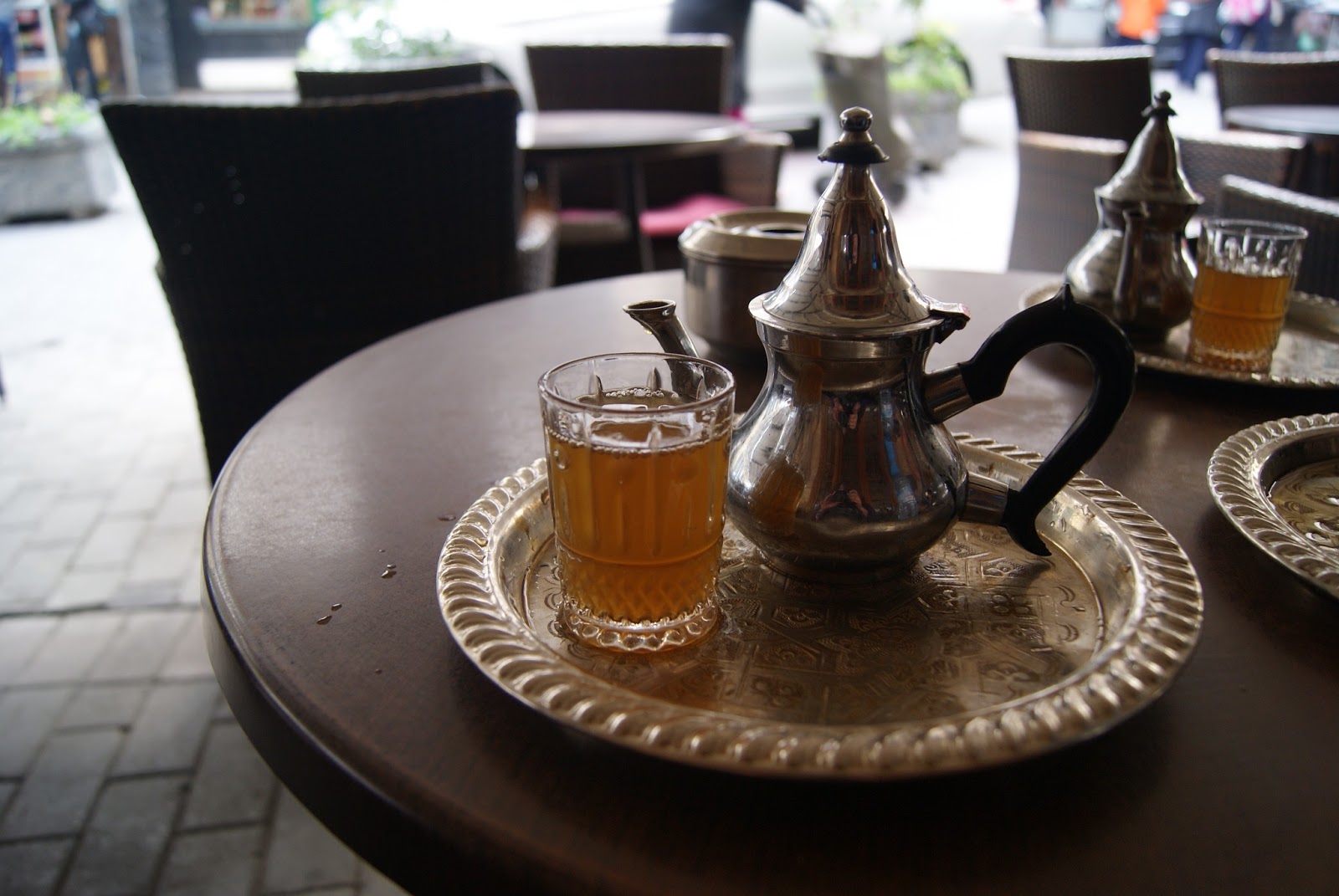 |
| Mint tea or heaven. |
 |
| Speechless. |
Madrid: Art.
Our stop in Madrid was short, about 36 hours. I spent most of the day in museums, The Prado and The Reina Sophia. I did have the opportunity to cross a few pieces off of my Art History Bucket List, including Picasso's Guernica and Dali's Girl at the Window (not so well known, but a painting that has always enchanted me) I also had the chance to meet up with a friend from my study abroad time who is now living in Madrid and eat some tapas. I love tapas because you get to have a little taste of everything, something like this adventure!

Our stop in Madrid was short, about 36 hours. I spent most of the day in museums, The Prado and The Reina Sophia. I did have the opportunity to cross a few pieces off of my Art History Bucket List, including Picasso's Guernica and Dali's Girl at the Window (not so well known, but a painting that has always enchanted me) I also had the chance to meet up with a friend from my study abroad time who is now living in Madrid and eat some tapas. I love tapas because you get to have a little taste of everything, something like this adventure!
 |
| Girl at the Window, one of favorite paintings ever. |
 |
| The Crystal Palace |

 |
| Giant wall gecko? I just love Madrid!!! |
Friday, February 15, 2013

Tuesday, February 5, 2013
Rome: The Unfathomable City
There’s
something strange about the city of Rome, for me. It just seems surreal, unreal, even. And every time I go there, I have the strange
sensation of being surprised to find it more or less exactly how I left
it. But why?
Rome is, of
course, The Eternal City, by everybody’s estimation, but if I were asked to
give it a name, I would call it The Unfathomable City.
Walking through certain parts of Rome is like
stepping into an onion: history resurfaces in layers.
The Roman Forum is perhaps the best example
because it is there that, in one sweeping vista, you can see the remains of
buildings from the time of the Roman Republic (and earlier!) stacked up against
triumphal arches from Imperial Rome, next to Medieval churches, next to ancient
temples turned into Baroque churches, with a 20th Century monument as
the backdrop to all of it.
 |
| View of the Roman Forum |
Of course, many cities have histories
as diverse and as rich as that of Rome, but there are few places I can think of
where things have been so meticulously dissected and left for contemplation in
the way that Rome has.
It’s simply
unfathomable.
Walking in
the Forum, I feel so small, standing
next to structures so colossal that even the fragments are larger than
life. But I can’t help but appreciate
the sheer size, the largeness, the
grandiose nature of my surroundings and feel a part of it. The paradox for me is something unfathomable.
 |
| Constantine's Basilica |
Stepping into a Rome firmly
grounded in 2012 leaves me equally perplexed.
Cars and tall buildings, wide streets: nothing like the tiny, winding,
one-way Renaissance streets of Florence that were clearly designed when horses
and feet as the primary modes of transports. Rome can hold its own among the world’s other
great capital cities. For me, it’s
overwhelming, unbelievable and, above all, unfathomable.
Rome is of
course, not a city that can be contained in a blog post or put into so many
words, but, in my attempt to help you better understand what it is like to be
in Rome, I leave you with one image, one of my favorite places in the city:
Picture the remains of 4 Roman temples dating from the 4th Century to the 2nd Century BCE.
This place was once a sacred spot, but now, large roads run on either side of the space, crammed with
trams, buses, cars and pedestrians. The holy space of years gone by can be seen only in the outline of the few remaining columns.
 |
| Photo from Wikipedia |
Close your
eyes for a moment. Imagine a grand,
classical, sacred space. Everything is marble. Or better-- gold! People
approaching the temples with their petitions, eyes cast down, in
fervent prayer.
Now open your eyes and
look down. There are several cats
sitting calmly at your feet. You look
down and see their brothers and friends sprawled out on the centuries
old stone, napping and taking in the golden Roman sun. Because centuries have passed in a moment: this space has gone
from being a holy place to being a refuge for the stray cats of Rome.


Imagine the historical confusion of the stones!
Picture the priests solemnly carrying out their solemn offerings to the
gods.
Flash forward.
Now picture the stereotypical gattare (Italian cat ladies) carrying out a huge pot of pasta for the 250 cats lying around the ruins.
In my mind, these images are laid one upon
the other like a double-exposed photograph.
And I find the combination confusing, disconcerting, unfathomable.
And I realize that after so much time spent in Italy and so many visits to Rome, I have only begun to understand this city.
 |
| The Colosseum |
Subscribe to:
Posts (Atom)