Tuesday, March 25, 2014

Thoughts from the Porch of the Pantheon


I am sitting here in my own little corner of the Pantheon porch, which is a very small corner indeed when you consider how many other corners of similar size this universe contains.  And while I am sitting, I am confronting my own smallness.  It is not the kind of smallness that is measured in inches and meters, although even standing on the tip of my toes and reaching my hands as far as possible, I may as well reach for the stars as for this ancient roof, for I am small in that sense as well.   But even though this space is tall and wide and deep, its perimeter is not the sum of its greatness.  Rather, in addition to being very tall and very wide and very deep, it is long, long, long. This kind of length is measured in minutes and millennia and is enough to put me face-to-face with my own minuscule-ity.
            
Meanwhile, a little corner of humanity has begun huddling under the porch to take cover from an approaching rain storm.  Although it seems like a torrent of people from where I'm sitting, I must remind myself that this corner is a very small corner indeed when I consider how many other corners of similar size this Earth contains and has contained.  It makes me wonder about all the great men and women who have passed under this roof.  And, even more, I wonder about all the other men and women, who were perhaps not actually less great but only less memorable to the slippery annals of our histories.  For it is not only the so-called “greats” that have made us, but equally, or perhaps even more so, those folks in whom we would recognize ourselves if we were able to look through time the same way we look in mirrors.  These people were left out of writing the stories, but it was, nonetheless, their lives and loves and triumphs and forgotten struggles that bound the book.  Just as individual letters fill and give meaning to a page, their lives filled and gave meaning to the Earth.  Yet, just as we would be hard-pressed to identify the individual importance of any single, isolated letter, we would be hard-pressed to describe even one of their faces.  Even so, they have shaped our world and made, literally made us.

And in all of this conglomeration of humanity over space and time, where does that leave me and my little corner?  Where does it leave my companions who have, at least for now, managed to escape the rain?  I imagine we will all stick around for a while and leave with brighter skies.  After all, this rain will not last forever. These long columns, which have seen their fair share of rain storms, could surely tell us that.  Nor will we last forever, these columns could also tell us that.


Thursday, February 20, 2014

Living in Poetry

A very dear friend of mine and I have been having a virtual discussion about poetry.  To be honest, I know very little about the subject, but have learned a lot, just through our ongoing dialogue and am looking forward, as always, to reading and learning more in the future.

There's something about a particular passage that she sent me to read that has really got me thinking, not just about poetry, but about how the broader scope of an idea:

"Here’s a tricky issue: the task is to grasp, to connect, to understand. But such a task is to some degree impossible, and most people want clarity. At the end of class, at the end of the day, we want revelation, a glimpse of the skyline through the lifting fog. Aesthetically, this is understandable. Some magic, some satisfaction, some "Ahhh!" is one of the rewards of any reading, and particularly the reading of poetry. But a poem that reveals itself completely in one or two readings will, over time, seem less of a poem than one that constantly reveals subtle recesses and previously unrecognized meanings...The most magical and wonderful poems are ever renewing themselves, which is to say they remain ever mysterious."
(Borrowed from "How to Read a Poem: Embrace Ambiguity")

Travel, to me, is always surrounded with an air of poetry.  Everything is new and never before seen, I see all the details of every street that I walk down, because I am constantly trying to better understand the place.  Eating a new food or meeting new people inspires the kind of instantaneous, ecstatic reaction that it's impossible to immediately capture in even the loveliest prose.  It's more like an impressionist painting or a poem-- a sensation that can not be fully understood in just one moment or one glance, just one reading. I find myself re-living these moments over and over again in my mind.

And it takes me to a passage from Invisible Cities by Italo Calvino, which I'll translate (quite roughly, as there is really no such thing as a clean translation) into English here:

"The more he loses himself in the unknown quarters of faraway cities, the more he understands the other cities that he crossed up until that point and he re-traces the steps of his travels and learns to know the port from which he set sail and the familiar places of his childhood and the surroundings of his home and a little place in Venice where he ran as a child."*

It is only by immersing ourselves into the unknown, that is, into the poetry of life, that we can begin to understand where we came from and how we ended up there.  The obvious and the straight-forward do not require that leap-of-faith, that uncertainty, that ambiguity where we find the room to grow.

It's easier to go through life with a closed heart and a closed mind,  If we are going to truly lean into our lives, truly "embrace the ambiguity," it takes a lot of courage.  After all, ambiguity, by its very nature, makes us uncomfortable.  It's much easier and more comfortable to live in an instruction manual than a poem.  The next step is always obvious and there is minimal risk involved.

But there is where is the joy?  Where is the growth?  Where is the beauty in a life like that? Life, like good poetry, should be a challenge.

That's why I'm most grateful for all the places I've never visited and all the people I've never met.

That's what fulfilling friendships and relationships are built on, discovering something new in a person that you knew through and through.

That's how a world I thought I understood manages to confound me anew every day in the most beautiful way.

---

*I'm including those sentences from Le citta' invisibili by Calvino here in the original Italian, so that those of you who can read Italian will be confirmed in your suspicion that Italo Calvino was actually a significantly better writer than I am:

"Marco Polo immaginava di rispondere (o Kublai immaginava sua risposta) che piu' si perdeva in quartieri sconosciuti di citta' lontana, piu' capiva le altre citta' che aveva attraversato fin la', e ripercorreva le tappe dei suoi viaggi e imparava a conoscere il porto da cui era salpato, e i luoghi familiari della sua giovinezza, e i dintorni di casa, e un campiello di Venezia dove si correva da bambino"


Sunday, November 24, 2013

26.2

I have a couple weird hobbies, things that other people probably wouldn't count as hobbies, but I do.  At the top of the list is going out to dinner.  Second is people-watching.  And, as of today, I'm adding "cheering for people at marathons" to the list.  I guess that it could just be "cheering" or "encouraging" or "affirming" in general, but there is something that I love particularly about marathons.

One thing is that, for the most part, the people that run in marathons are not professional athletes.  It does take a lot of training and dedication, but I think that most people who run marathons are just normal people who have worked really hard.  They have jobs and families and many competing priorities, but they also take their running seriously.  I don't think I would ever choose to put in the work it takes to run 26 miles at one time, but I respect the people that do.  

And there are about 10,000 people in Florence today that did just that.  I volunteered at the marathon for a few hours today and then stayed to watch the first finishers (which, incidentally, was way cool.  Florence even had a race for differently-abled people who used hand-bikes!  Awesome!) but as I was walking home, I stopped to cheer on some of the runners....and ended up standing there for about an hour, cheering non-stop until I was starting to lose my voice!  And it was the best!

The podium for athletes who participated on hand-bikes!  Too cool!
Some people might say that the reason I got so much enjoyment out of this is because I'm weird and while there is some truth there, I have to wonder if there is some greater force at work.  When I'm watching people run a marathon, I can't help but think that, in some ways, we're all running this race, all the time.  Sometimes there is triumph, sometimes there is pain, but at the end of the day, you have to just push through everything and get to the next day, regardless of how much it hurts or how tired you are.  Our lives are kind of like a marathon.  But we don't wear numbers or get fun sweatshirts or have people standing at the sidelines cheering us on and handing us water.  

But maybe we all have a time when we need someone, even a stranger, to tell us bravo!, forza!, dai!  Sometimes we just need someone to say I see you, I acknowledge your struggle, but it's okay, you're going to make it.  

Looking back, I recognize that I would be lost, save for my own cheering section, helping me through every step and mis-step.  And I hope that at least some of you remember hearing my voice during your own races.  

Friends, I hope that whatever this week may bring you, you realize that you have at least one fan cheering you on. And I hope you'll make some time and effort to acknowledge someone else's struggle and accomplishments.

Braviiiii! Braaaviiiii!!! Bravissimiiiiiiiii!!!

As far as cheering sections go, I'm obsessed with Florence's sbandieratori, the Renaissance flag guys....

The winner of the day: Stikovsky Oleksandr (he's Ukrainian!)
And notice the flags in action!


Friday, October 18, 2013

Finding the Right Words

By the way, I wrote this while sitting in
an enchanted garden.
There is a very particular frustration in trying to find the right words in a language that is not your native tongue.  The feeling is so specific and unlike any frustration I've ever experienced before that I think it merits it's own descriptive word.  I can't help but think that some language, somewhere, must have such a word!

The only analogy I can draw, is to the feeling I have had many times during a recurring dream (I'm sure someone reading this will find some hidden interpretation here) where I am using all my force, exerting every ounce of power I can draw out of my muscles, yet only moving in slow motion, as if running through a pool of water.  Because when I'm searching for words, sometimes it feel like I might stop breathing or my heart might stop beating because every last neuron is firing trying to connect whatever abstract idea is in my mind to some particular word.  And a lot of times, not matter how hard I try, I feel like I can't find the right word, either because I have never learned it, or else I once learned it and have since forgotten it, or else it doesn't even exist.  The biggest problem is that I don't even know which of the three problems I'm up against at any given moment.  It's like putting together a puzzle that is missing some of the essential pieces but at the same time, has all these extra pieces that don't actually fit, without any sort of guide to tell you which is which.

At times, experiences and explanations and opinions and understandings exist in your mind in such a specific way, that it's hard to frame them with a language that you are still learning to own.  Or maybe you've never practiced putting that particular body of thought into words outside of your own language, or maybe it's hard to express a certain level of complexity, even in your native tongue.  But when you're trying to communicate, you can't always pause to have these philosophical discussions with yourself--you have to find a way to get your point across, even if your words feel inadequate.  Sometimes this is as simple as choosing a different word, but sometimes it's as complex as turning your thoughts upside-down, moving to the other side of the room, turning your head and squinting a little bit, to frame everything from a new perspective.  And that's just one sentence.

In some ways, speaking a new language requires you to do the same thing that an artist does, or an innovative businessman or a diplomat negotiating a treaty.  That is, to make one thing out of something else while working in the confines of your own knowledge and understanding, looking from a different perspective and balancing the relative importance of each word.  It's truly a creative process.

In some ways, learning Italian has taught me not just how to speak better, but how to live better.  I've learned diligence, patience with myself and my own abilities, fearlessness and the ability to stand exposed, weaknesses and imperfections laid bare, as that is the only way to learn.  I've learned that I can't always grow as much as I'd like to grow in a single day, but that over the course of a year, those incremental, barely-noticeable changes tend to multiply and even grow exponentially.

And I realize, even when I am leaving a trail of discord everywhere I go, even when I'm faced with a mound of accumulated, unnecessary and abandoned prepositions, even when my nouns are absolutely confused about their true gender and even when my subjects and verbs are left arguing so much because they just don't agree, that tomorrow is a new day to make fresh mistakes and (hopefully!) leave behind some of the old ones.

And I salute Dante and Manzoni and all the others, for the work that they've done to build up and solidify this beautiful language, even as I am doing everything in my power to rip it down, tear it up and try to re-build some semblance of something that is somewhat understandable as a human language.  Because I realize that a language is not like a picture hanging in a museum, something meant to be left, lonely and pristine, for centuries without any real human contact, but rather a piece of clay that is at it's very best when it is being changed, molded, rolled around and constantly reshaped.

And on the bad days, when I feel tongue-tied and confused, I remind myself that the most beautiful things in life, after all, are those that can't quite be captured in words.

I love these statues from the Bardini Gardens because I feel like they're having a conversation.
Or maybe he was like "Hey, girl, hey." and she was like "Nope, not gonna happen."


Monday, September 23, 2013

Paparazzi

I was having a conversation last night with a friend of mine who also works with students in Florence.  And we were talking about what it is like to travel with students on academic field trips organized by the school.

We agreed that one thing that makes us crazy is the absolute obsession with taking photos of every single thing and how photographing takes precedence over everything, including listening to the guide or trying to understand what the things in all the photographs actually are.  It's like a frenzy and I'm not exaggerating at all when I say that.  I have watched students run a little bit ahead, stop at every corner we passed and hurriedly snap four pictures, one in each direction.  And then run ahead to the next corner and do the same thing.  And with such urgency, you would not believe it, as if their very lives depended totally and completely on getting a picture of each and every street in Siena or Assisi or Rome or whatever city we were in.  It's comical, really, and a little sad.

The sad thing is that anyone in the world can view the events of our lives through our posts on Twitter and Facebook and Instagram—but I have to ask if we are missing out on something of the moment in our frenzy to share every last moment of our lives.  People always say things like "oh, it was so beautiful, a picture doesn't even capture it,"--so what are we missing out on when we see our own travels (or even our everyday lives!) primarily through the lens of a camera or an iphone?  Were we actually there?  Or are we seeing our own lives from the outside?

One of my favorite "fun facts" to share with people is the etymology of the word "paparazzi."  The word comes from Federico Fellini's masterpiece, La dolce vita, which, incidentally, is one of my favorite Italian films ever and a film that everyone should see at least twice.  At any rate, in this film, Paparazzo is the last name of a photographer who is friends with Marcello Mastroianni's character and has a habit for being in the right place at the right time, particularly at sensitive moments in people's lives as the story unfolds.

Without going into a full analysis of the film, suffice it to say that a recurring motif is depicting the way that our constant obsession with media, photography and documenting things  disrupts sensitive and important moments in our lives and even in our society.  Although Fellini claimed that he was not aiming for satire, but rather just depicting reality, there is surely a satirical underpinning at work here.  Keep in mind that this film came out in the year 1960.

Flash forward to the year 2013, over half a century later, and I would love to know what Fellini would have to say about the current state of things. It would look a little bit different, I think because it is not longer just the media with bulky cameras and elaborate set ups, it's each of us, looking at the events of our own lives through a screen.

To an extent, we have all become the paparazzi in our own lives.

And I'm not trying to sound preach-y here.  I recognize my own culpability in all this and that I am not somehow immune from the addiction to over-sharing.  Although I made fun of Instagram for a long time, I have recently become obsessed with it myself, a self-professed hypocrite as sure as I stand!

In fact, I'm almost certain that, if such studies don't exist already (and if they do, please send them my way!), in the next few years, we will see research about how all this snapping and sharing is changing our brains.  I'm not a psychologist by any means, but I'm certain that sharing prompts some kind of chemical release in our brains that makes it addicting.

Am I advocating that we tear ourselves away from all technology, photography and social media?  Well, no, not exactly.  Technology is a tool which, like a knife that could be used to kill a man or to help us share our bread (not my words, but a metaphor that I love!).  We can choose to use it to destroy ourselves or to create a better world.  Pictures can be powerful and the potential for the good that can come from sharing could be exponential. When we share photos from our travels, the world becomes that much smaller, which is a powerful thing and one that could be a tremendous force for good. To give an example, I follow a handful of photo-journalists on Instagram and have been seeing images from Egypt and Afghanistan that help me to put human faces to places I've never been and struggles I can't truly fathom.

What I'm really getting at is awareness.  I'm not living in a fantasy world and I'm not telling anyone to pull a Henry David Thoreau and abandon all connections to civilization to live secluded in the woods. But I am saying that when you see something beautiful or incredible, don't immediately reach for your phone, but rather take a minute to appreciate the moment you are living in.  If you absolutely must snap the picture, limit yourself and take your photos consciously, not mindlessly.  Take one or two and then put the phone or the camera away. (In my experience, I get better photos this way, anyway!)  Recognize that, in reality, in a year, you won't remember how many likes that picture got on Facebook and probably won't even be able to find it, searching through the thousands of things that you have posted. (It's true!!)

Above all, I hope that we can realize that the value of the moments in your life is not measured by how well we documented them or how many pictures we took or how many people left comments on our Facebook page.  A better metric is how we connected with other people, what we learned and how we use that knowledge to better ourselves and the world.  And those, my friends, are things really can't be captured in a photograph.


-----

PS:

For anyone interested, I'm inserting a link to one of the most memorable scenes from La dolce vita.  Unfortunately, I couldn't find one with English subtitles, but I think the images are powerful enough to speak for themselves.

Also, if you click here, you can see a short, but brilliant video that pretty much sums up everything I just wrote.  It was viral a few weeks ago, so you might have already seen it, but if you haven't watched it, you absolutely should!!


Sunday, September 15, 2013

The Problem With Student Travel Companies in Florence

I will never forget waking up that first morning.  It was my Fall Break during my semester abroad and I was travelling with my roommate Jenny.  We were in a hotel outside of Barcelona and had arrived very late the night before.  For both of us, it was really the first time we had traveled on our own and we didn't know anything except that we had flights and some accommodations booked for the next ten nights: it was going to be a long trip and I would be lying if I said that I wasn't a little bit worried.

The next day, after dealing with the sudden appearance of pink eye (unpleasant, but, in the end, fine), we found a cute restaurant, on recommendation from someone at our hostel, and both ordered food, without really knowing what we were ordering.  Between us, we spoke an embarrassingly small amount of Spanish and, to admit something really embarrassing, I did not even know Catalan was a language until we landed in Barcelona...  I cringe a little bit writing that, but I remind myself that this is why we travel, to learn things that we didn't know before.

So, Jenny takes a bite of her mystery sandwich and discovered quickly that her sandwich contained walnuts.

"Erin, I have something to tell you," she said.

"Okay...."

"I'm allergic to walnuts."

My heart dropped a little, "maybe you should stop eating then...."

"I can't, it's sooooo good."

As it turned out, her allergy was not severe and we survived to eat many fantastic meals and went back to that place three times and every time ordered a mystery meal and every time we left full and satisfied. (The restaurant was called La Bascula--vegetarian, which is not common in Spain & lots of organic/natural things!)
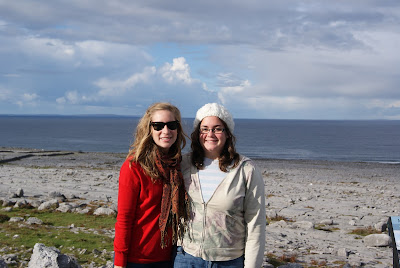
Jenny and I, 3 years ago in Ireland--savoring some time in the English-speaking world!

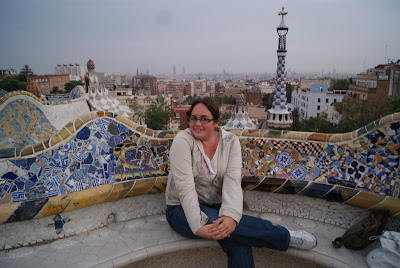
Being in Barcelona is like being on top of the world!!!

The point of this long, self-involved story is that we were clueless!!!  Completely clueless!!  But we made it through those ten days and we learned so much about ourselves, each other and, above all, the world!  We both learned a little bit about reading maps, argued and got stressed out when we got lost, stumbled through two languages (how surprised was I when I found out upon my return to Florence that I had been asking for "a bedtime story" instead of "the check" at every meal we ate in Spain!  Or when I booked bus tickets out of the wrong Valencia, Spain!).  When our skills as navigators and linguists failed us (which was often), we compensated with curiosity and sincere smiles--and had some help from locals along the way!  I often tell people that I learned more in those ten days than I everything I learned combined in my life until that point and, in retrospect, I wouldn't trade all the awkwardness or stressful moments for any other experience.

Which is exactly why it makes me so sad when I see students increasingly choosing to travel through companies rather than planning their own trips.  There are at least a half dozen companies in Florence that specialize in planning trips for students, but they all provide more or less the same experience:  for what you pay them, they will bundle your accommodations, provide you with a guide, maybe include some food and (joy of joys!) put you on a bus with fifty other American students (or more!) and shuttle you all around Europe.

And students tell me:

"It's so easy!"

"It's so comfortable!"

"They did everything for us!"

"They made sure we didn't stay in a bad hotel!"

The problem I have with these companies is not that they don't fulfill their promises--based on what I've heard, they do a great job of shuttling students around Europe, making them comfortable and taking them from site to site in Europe's most beautiful, historic cities.

In fact, the problem I have with these companies is that they do exactly what they say they do--they make everything so effortless and in doing so insulate students, in a bus full of Americans, from learning about the world around them and from truly experiencing the culture of the place they are in.  They take away the uncertainty and the frustration of travelling but in doing so, I would argue, they also take away the sense of curiosity and adventure.

I've spoken with people who traveled through Europe in the age before the internet and they have told me about what it was like, arriving in a city, suitcase in hand and literally searching through a phone book to find a place to sleep at night.  The truth is, travelling on your own is not that hard anymore.  There are dozens of travel sites and booking sites on the internet that provide dozens of reviews and information on attractions and accommodations. There is a huge selection of guidebooks for any of the major European destinations available in bookstores, both at home and abroad, and even on your device of choice (Anyone who has ever traveled with me knows that I LOVE guidebooks, and on the last few trips I have taken, I took my guide books with me via the Kindle app on my ipod!  All the fun of a guide book without having to lug around a huge book!  Miraculous!!!).

Yes, booking things on your own can require a bit of actual thought on your part and maybe some advance planning, depending on how adventurous you are (although with Wifi beginning to appear everywhere, including on flights and trains, perhaps even less now than ever!), but it gives you the freedom to do what you want, to change your plans (or travel without any real plans!), and to experience some of those moments of frustration and stress and clueless-ness that humble us and help us grow, as travelers and as humans, as well as leading us to moments when discover something extraordinary or meet remarkable people, both locals and fellow travelers.

I know that not everyone will agree with me on this, and this post may be controversial.  But I would like to start a conversation more than anything.  Of course, I have to recognize the fact that not everyone is looking to get the same things out of their travel experiences as I am.

I often use a quote by St. Augustine, "the world is book and those who do not travel read only the first page."  The kind of travel that I am advocating for is not measured so much by the number of pages read as by the experience of reading.  Did we really understand what we were reading?  Or did we just skim to find the main idea?  Did we savor the moments of poetry and of challenge in the text?  Did we actually learn something?  Can we think critically about it all or is it just a blur of photos on our Facebook pages?

There are some risks in planning a trip for yourself, not so much risks as in putting yourself in physical peril (especially in Europe, come on!), but risks that you will have moments when you will be pushed out of your comfort zone.  Not only is this a possibility, but something that I promise and hope for.  Because when you find yourself outside of your comfort zone, you are at risk of learning and of growing and seeing things differently.  It's a bit of a leap of faith, but one that I wish more students would take.

Saturday, July 6, 2013

Wanderings

Today I was walking to work and I saw some people talking excitedly, looking up and pointing.  What are they looking at? I asked myself.  They seemed so enthralled that I couldn't resist turning around to see what had captured their attention.  And I saw Florence's cathedral and Brunelleschi's dome, surrounded by tourists and caricature artists and people taking photos....but nothing was out of place.  So I looked back at the people again, to see if maybe I had misjudged where they were looking.  But I looked at their eyes and saw that they were still just as excited and pointing just as clearly.  Seriously, what are they looking at?  Their eyes were fixed directly on the cupola, but the more that I looked, the more I could not understand what they were looking at.  Is there a bird up there?  Something that I'm missing?  My eyes were searching for something, anything.

Then it hit me.

Oh.

They were not looking at something on or near the dome, they were just looking at....the dome itself. Brunelleschi's dome, one of the great miracles in the history of architecture, arguably one of the greatest achievements of the human mind...ever.  It was the biggest dome in the world when it was built in the fifteenth century.  Even when Michelangelo built a bigger dome, the dome of St. Peter's Basilica in Rome, he noted that his creation could be "as big, but never as beautiful."

And so it has happened that this amazing piece of living, breathing history, that I imagine even Michelangelo paused to admire as he walked by, has become such a part of my daily routine that I could not even see it.  I had not even realized the extent to which I was rushing through that morning until that moment.  It reminded me of how important it is to stop, and take a deep breath, especially when I feel that I do not have time to do so and appreciate what I have right in front of me...


***

Walking in the most tourist-filled streets of Florence is something like walking through the entire world condensed into a few blocks.  More than anything, I listen for all the different languages.  Maybe I hear someone speaking German and someone speaking Swedish and someone speaking Japanese and someone speaking a language I could not even recognize if your life depended on it...all at the same time.

And I'm always tickled, to hear sounds that are so thoroughly foreign.  Above all, I love languages that are so different from anything that I know that I can not even separate individual words or sentences.  And sounds pass through my head and I can't even wrap my mind around the fact that those sounds, which to me sound totally random, actually mean something, actually mean a lot, when passing through someone else's mind.

And I remember what Italian sounded like before I could understand it.  Before I even understood the rhythm.  I remember sitting in my dorm room, doing speaking exercises during my first semester  of college and feeling the soft vibration that the words left on my tongue.  And how it lingered for a moment, even when I stopped speaking.  It was delightful.  How I wished, in those moments, that the feeling never had to go away!

I wonder, when I hear these other languages, what kind of feeling they leave on your tongue or on your lips.  And if I might someday roll Hungarian or Polish or Chinese around in my mouth, what those words would feel like, what they would taste like.

I think of how my life has been enriched by learning a new language.  How I have come to better understand a culture and a people, through the language and how, like one of those beautiful, antique keys, it has opened some special doors.

And suddenly, I want to know all the languages that the people around me are speaking, all at once!  Why couldn't I know every language in the world in a single instant?  But the very thought makes me dizzy.

Because I know that knowledge like this comes slowly and with effort.  Learning a language is like building a relationship, it takes time and patience and is, honestly, a bit messy.  Nothing meaningful can be achieved in a single moment.  It is the months of learning, the countless mistakes and the reaching beyond your comfort zone that make learning a language a meaningful experience, that make any experience meaningful, really.  And I wouldn't have it any other way.

So, I continue to walk on, quietly delighting in fragments of other people's conversations that I will never understand.