Recently, I've been reflecting a lot on what my time here in Italy has meant. I am fast approaching the three-year mark of my time abroad and possibly also my farewell (for now) to the life that I've built here. I start to ask myself not only what it all means, but who I am, where I fit. And the answers are perplexing and fraught with contradictions. I've spent too long in Europe to use the unmodified word American to describe myself. I've considered American?, American... and even American-Italian (the inverse of Italian-American), but nothing sticks.
When I'm meeting someone Italian, I usually answer the question of where I come from with a deliberately not-simple response: "SonoamericanamahovissutoinItaliadatreanni." ("I'mAmericanbutI'velivedinItalyforthreeyears.") It's a sentence best pronounced breathlessly, without any spaces between the words. Not until recently did I realize that I could choose to preference a different conjunction, saying with a greater sense of harmony, "I'm American and I've lived in Italy for three years." But and feels somehow sythentic--the clear choice has always been but. It's as if the second part of the sentence somehow negates the first part. In a single word it contains I know the city center of Florence better than my own hometown and I really hate Starbucks* and most importantly, I'm desperately trying to understand the culture here in more than just a superficial way. I would include those details too, if I could talk longer without taking a breath and if I didn't think that most people were asking just to be polite.
But the negation works both ways. After all, I lead the explanation with my American-ness because without that detail, nothing else makes sense. I have a need to speak and read and write in English (a need that someone who has never left the English-speaking world inevitably takes for granted). I have my education, based very much in American methods of thinking and learning. I constantly crave peanut butter and French fries no matter how much I love the food here. Finally, I completely lack the ability to understand the niceties of social context necessary to properly use the infamous formale. These things are a part of my identity too. No matter how long I have been here, I am a foreigner, a straniera. (Thanks to a lovely linguistic trick, the word straniera conveniently has the word strange, strana, built right in, which makes further explanation somewhat unnecessary.)
In the end, I come back to the smallest word, the one that is simultaneously the most and least loaded of all the words: the but. That unresolved tension, the word on which the paradoxes hang is maybe the most important part of my identity at this moment in time. It's the root of all the frustration and uncertainty, that feeling of never being one hundred percent at home anywhere. That said, it's also where the beauty comes from, the thrill and an awful lot of the joy. The magic of the but is that it is necessitated by two things, by two identities, by two different worlds. It implies a life that is confusing and less-than-straightforward, but also extremely rich, textured and diverse. It's everything and nothing, that word. It leaves me feeling full and empty at the same time, loved and lonely, fragmented and complete--but never bored, never unchallenged.
And I could take or leave....but, on the other hand, is here to stay.
----
*At risk of being accused of being a fraud by certain people, I should clarify that my relationship with Starbucks falls more on the spectrum between love-hate and love-to-hate than I'm willing to admit.

Friday, May 29, 2015

Sunday, April 26, 2015
Away With Words
Communication can be difficult. I remember groping my way blindly through my third semester Italian class. That's the semester we learned to formulate hypothetical statements which in the Italian language is a complex and nuanced art form which like painting or gold smithing, can take years or even decades to truly master.
I remember one day another student, in the middle of a grammar exercise, cried out in frustration,
"I just can't tell the difference between reality and imagination!"
"That," responded our professor who was wise and Sicilian, "is the result of watching too many Disney movies as a child."
And it makes me laugh to think about it now, but there's an unexpected bit of truth in it. Language is like a filter in our brains through which all of our thoughts have to pass. It affects our perception of time, of essence, maybe even of where the line is between what is real and what is hypothetical. It's one of a million reasons that two people having the same experience can perceive things differently.
As for me, although I would not consider myself fully bilingual, I do live bilingually, in constant flux. But "bilingual" is a term I don't like. I have always been resentful of it because it implies that there are two different systems that can be kept separate, that there is a switch that you hit or a line that you cross and suddenly everything has changed. Now in English. Ora in italiano.
If only the world were so clean and clear cut!!!!
Linguistically speaking, it's more of gooey, melty, sticky mess. Picture a dog eating peanut butter. When I think about writing, speaking or social interaction within this inescapably bilingual context, a life experience that comes to mind is the time I almost drowned in one of those playground ball pits when I was a child. I feel like I'm constantly flailing around, grabbing for something, for anything that is solid. Searching for the right words, you take what you can get and hope to make it out alive. It's chaotic and confusing and crazy, yet somehow in the end, I always find myself wanting more.
Of course, I expect that there will be some lingering traces of English in my Italian. It's my native tongue after all. What I did not anticipate is the way that Italian has crept in and taken up residence in the English-speaking part of my life.
The idioms and Italianisms are inescapable! Suddenly, I find myself asking my friends if they would like to take a coffee with me. I picture myself running up to the counter with a ninja suit on, grabbing the espresso and making a run for it.
We don't say that in English, I remind myself.
And come in language, cosi' in life. I find myself feeling like I am constantly caught between two different cultures: too American to be proprio italiana and too changed by my experiences abroad to be simply American.
At moments, it's a priveleged position. I've always enjoyed having the opportunity to be the go-between, the translator, the mediator. Building bridges suits me; it's a role in which I find fulfillment. But at moments, it can also be confusing, frustrating and even lonely. When my thoughts wander towards the existential, I start to consider questions like where do I belong? At times, it feels like the answer is everywhere. At other times, nowhere. The line between the two is astonishingly thin.
But sometimes I find a place where everything falls away into a quiet tranquility. Sitting on the couch in a close friend's apartment with a glass of wine in hand. Whatever challenges the universe may present to us, we are in it together. At the corner table in my favorite restaurant where the waiters greet me with a warm smile and kiss on the cheek. Somehow food tastes better when you can shake the hand that prepared it. A scenic place to sit in the springtime sunshine.
And come in language, cosi' in life. I find myself feeling like I am constantly caught between two different cultures: too American to be proprio italiana and too changed by my experiences abroad to be simply American.
At moments, it's a priveleged position. I've always enjoyed having the opportunity to be the go-between, the translator, the mediator. Building bridges suits me; it's a role in which I find fulfillment. But at moments, it can also be confusing, frustrating and even lonely. When my thoughts wander towards the existential, I start to consider questions like where do I belong? At times, it feels like the answer is everywhere. At other times, nowhere. The line between the two is astonishingly thin.
But sometimes I find a place where everything falls away into a quiet tranquility. Sitting on the couch in a close friend's apartment with a glass of wine in hand. Whatever challenges the universe may present to us, we are in it together. At the corner table in my favorite restaurant where the waiters greet me with a warm smile and kiss on the cheek. Somehow food tastes better when you can shake the hand that prepared it. A scenic place to sit in the springtime sunshine.
These are life's less-discussed joys: friendships that are equally comfortable in silence, glances that say everything without words, the first bite of your favorite meal, the tingling warmth of sunshine on bare skin for the first time since winter. These things are beautiful, maybe because they don't require words or maybe because they're beyond words.
Maybe because it's those little things that occasionally leave you speechless.
Monday, March 9, 2015
Finding My Way
Recently, I've been running up against this word, a word that I hate so much it makes my blood boil, just hearing it. A concept that I feel like I'm constantly defying, pushing back against, trying to tear down. But trying to break through this idea, it's like going up against a wall: I can hit and punch and fight, but ultimately, the wall is still there and not any worse for the wear. The word is perfection. And everytime I hear it, it makes me want to scream.
Because we have this idea that perfection is something that we can attain, that we need to attain. The perfect body, the perfect partner, the perfect house, the perfect life. But we find in this life that we can never be skinny enough or pretty enough or rich enough or successful enough. There will always be someone on Facebook whose life looks more appealing than our own. When we seek our happiness from perfection, we talk about it like an earthquake, something that will just violently and suddenly happen to us, without warning, when all the conditions are just right. It is something that we have no control over, that is totally beyond our reach.
It leaves us afraid of the messy and the uncontrollable, the things that don't fit in the proverbial box that we have already decided must contain our whole life. Some of the things that won't fit are failure and uncertainty, ruining everything and looking like an idiot. I'm not sure about all of you, but I've encountered so much of these things in my life (and in myself) that I've had to expand my proverbial box to accommodate plenty of screw ups.
But where does this fear of failing come from? It is the nervousness of standing in front of the blackboard trying to do a math problem in front of the whole class (show your work!). It is the anxiety of giving a presentation at work, speaking before a group of people whose respect you value (In conclusion...). It is the excruciating decision of which words you will choose when you are talking to the someone who means everything to you and you want to pronounce one of those painfully simple yet painfully difficult phrases: I love you or I'm sorry.
I have seen it in students over the past three years as they try to tackle the Italian language, which is a struggle that I've personally been living along with them. At the beginning, there is always the fear that you will make a mistake, or say something wrong or look like an idiot. I want to tell them that if they keep working at it that they will stop making mistakes, stop saying things wrong and be perfect. But the fact is that in language learning as in life, you never stop making mistakes, you just learn that most of the mistakes ultimately don't matter: sometimes they're even funny, sometimes they're even useful. At a certain point, you accept imperfection as a fact of life and you get over it.
Recently, I've felt the need to remind myself to think of my life in the same terms.
Maybe it's especially because the last month has been overwhelming for me. Moving to a new city and starting a new job, coupled with all the usual general daily frustrations of being an expat, of being a foreigner has proven enough to drive me insane at moments. There are days when I feel like I can't do anything right! (Let me remind everyone once again to please be kind to the foreigners and stranieri in your life--we need all the help we can get!)
And all this has me asking myself how my life would be different had I chosen a different path, a different course, one with fewer rocks and pitfalls and places to stumble. I think all of us twenty-somethings have at one moment found ourselves scrolling through Facebook, comparing lives with our friends and thinking to ourselves in a moment of existential panic, has everything I've done up until this point been some kind of a terrible mistake? Am I wasting my life?
I think we're all looking for road signs here, for things to reassure us that we're headed in the right direction. We want the clarity, solid lines, definitions and borders that we took for granted growing up. But what nobody ever bothered to tell us in school or in college is precisely how messy life can be. It's less a peaceful stroll in the park and more one of those military-grade obstacle courses. With mud. Lots of mud. Did I mention that it's also raining? We'll reach the end eventually, but not without a lot of sliding, a lot of falling and a lot of pulling ourselves back up, even when we'd rather just throw in the towel.
Life isn't some kind of an equation that we solve, discovering at the end that x=42, as much as we would like it to be. Usually, I have found that x=? or x=some-imaginary-number or something equally frustratingly unfathomable. Although we want to see in black and white, reality is fraught with grey areas and ambiguity and moral dilemmas and paradoxes that we will never "solve," never reconcile with our beliefs or the world that we so desperately want to live in and it is for that reason that we will continue asking ourselves is this all some kind of terrible mistake??? If you're not asking yourself that question, maybe you just haven't thought about it enough.
But to be honest, I was never satisfied with answers that didn't lead to more questions and I've always thought that those people who claim to "have it all figured out" are either lying or terribly deluded. I'm learning to enjoy a good roll in the mud, or at least learning to have a good laugh about it afterward.
Being human, I will probably continue scrolling through Facebook and making comparisons when I shouldn't. I'll see friends who appear to be doing significantly better than me at taking a perfectly respectable path, doing better than me at having things like stable jobs and houses and spouses. And I'll wonder where that leaves me and whether or not I'll eventually find the right way, the perfect way.
But then I'll remind myself that there is no manual on how to do this, no surefire 100% money-back guaranteed guide to perfection. At the end of the day, we're all playing by ear, making it up as we go along. My choices constitute as valid an attempt as any and so do yours and yours and yours.
Will we ever find our way?
Maybe there is no right way.
Friday, December 12, 2014
How I Made Peace With my Last Name
“They are a
generous and warm-hearted people and these traits must have belonged to their
ancestors from the earliest times.”
-A few words by Richard Foley on
the O’Heffernan family, from the biography of 18th-century poet Liam
Dall O’Heffernan*
It’s the
second day of lessons and the professoressa
at the front of the room is calling roll.
The last names of the other students roll gracefully off of her tongue,
beautiful, melodic Italian names with vowels to spare. It’s all a,
e, i, o, u—sounds that
gently leave her lips and flit around for a second like butterflies before
gracefully disappearing.
But it
happens when she starts to call the “F” names, suddenly I am conscious of my
heart beat in my chest. By the time she
reaches “G,” my heart is racing and I realize that I have a death grip on my
pen. Is the room suddenly really warm or
is that just me? And when I see a brief
look of puzzlement on her face, there is a pause. I know that she has arrived at my name. There is no vowel at the end, no easy place
for your tongue to gently leave the word.
That could probably be forgiven if it weren’t for the horribly breathy
H+e combination at the very beginning.
It’s a cursed pairing of letters, something terrible, an arrangement so
frightening in the Italian language that it can only be read with a
down-turned, uncertain scowl and inevitably followed by a markedly pronounced
question mark.
“Eeeef-fer-NAWN? erEEN Eeeef-fer-NAWN?”
Timidly,
I lower my eyes and raise my hand and in the littlest voice I can find…
“si.”
Yes. I’m here.
Likely,
the reality of the situation is that everyone is staring at their phones, not
paying any attention at all to me—but I can’t help but feel as if all eyes are
on me and all ears on that name. I feel
exposed, my foreignness laid bare. I’m not from around here, my name
announces proudly to anyone that is even a little bit listening. Once again, my last name has betrayed me. I just want to hide.
Having
an unpronounceable last name makes even simple tasks difficult. Signing for a package from the FedEx
guy? Forget about it. When you pronounce the name you just signed,
he gives you a look of profound confusion.
Making reservations for something?
Don’t bother—better to use someone else’s name or better yet make up a
fake one. And God forbid you should have
to spell out your email address. Excuse
me, but do you have an hour and a half to discuss this?
And for
months (maybe even years at this point), I have been secretly trying on other
people’s last names in the way that other people try on sweaters. How much easier would it be a Rossi? Bianchi?
Innocenti? I picture myself walking
around, randomly introducing myself to strangers on the street, for the pure
ease of it all! How lovely it could be! Si, tanto piacere! But something feels un-genuine about
appropriating other people’s names.
After all, a last name with no past is like a tree without roots. Not to mention, it’s creepy.
So I
decided that if I must be branded with this name, if it is bound to follow me,
stamped on passport no matter how far I travel—maybe I should learn to
embrace it. And so I started to learn.
As it
turns out, “Heffernan” or an alternative spelling “Hiffernan” both derive from
an old Irish Gaelic family name, “Ua h-Ifearnain,” a name which I had to copy
letter for letter out of the pages of a book* because it looks so dreadfully and
delightfully foreign. It possibly comes from the
Gaelic word meaning “horse-lords” or more interestingly, “spawns of Hell.” It’s an ancient name too, which appears in
the written records for the first time in 1047* (!!!!!).
And
trying to sift through names of people and places I can scarcely understand or
recall, grappling to pin down long-gone, forgotten societies of which I know nothing,
I realize that history is multi-leveled and multi-layered. And it makes me feel fragile to settle with
the fact that my blood and my genes, the fabric of me, my eventual existence
all hang in the balance of these other lives and loves and kings and wars,
twists and turns that are so far beyond my grasp. 1047 is a long time before my great-great-great grandfather, John Heffernan arrived in America in the 1850s
and an even longer time before I am sweating in a classroom in Italy, embarrassed
by the inevitable unpronouncibility of my name, returned to the Old World, but
not quite back to the country that John Heffernan fled all those years ago, a
place he would hardly recognize now.
But out
of lists and names and counties and anecdotes, there emerges in my study the
eternal constant of change hard at work. There is movement of people facing war or
political exile or famine, re-emerging and re-settling, loving and living and
fighting and doing it all over again the next generation. And in the New World, the blood of those
“generous and warm-hearted” folks would meet blood from other reaches of the
world and somehow the outcome (or more accurately another intermediary form) is me,
me and this name, surviving long beyond all those poets or scholars or
horse-lords or whatever. And I take
comfort knowing that it will surely out-live me too, that I am but a single
chapter in a greater narrative.
And
looking at all this movement and change over the centuries, I can’t help but
wonder how many Ua h-Iefearnains and O’Heffernans and Hiffernans have shared my
experience of being a stranger with a strange name. Certainly a whole generation did with the
anglicizing loss of the “O,” signaling the eventual loss of the entire Gaelic
language. Certainly John Heffernan did
when he arrived as an Irishman in a country that remained hostile towards the
Irish immigrants, fleeing a desperate famine. And I come to understand that this bastardized pronunciation is only the most recent development in an unfathomably complicated story. Names, like the humans they designate, are not fragile, static things. They don’t sit on shelves or hang on walls or
rest undisturbed for centuries—they are malleable, changeable and most of all
transportable. And in carrying this name with me, I am part of a noble tradition.
And
after all, erEEN Eeeef-fer-NAWN, it has a nice ring to it, doesn’t it?
---------
*I’m
drawing from a book called The Heffernans
and their Times: A Study in Irish History written by Dr. Patrick Heffernan. Thanks to my Dad for sharing it with me and
for generally being a great source of Heffernan history.
**I'll also add that the professore eventually settled on calling me by my first name, a benevolent gesture sparing everyone involved a lot of frustration.
Monday, November 10, 2014
On Light and Darkness
On my recent visit to Lecce, I really fell in love with the leccese baroque style of architecture. What Baroque things I see in Florence or in Rome have tended to overwhelm me and to make me want to run and hide, escaping into a room of Renaissance order or Medieval stylized predictability. But in Lecce, everything was elegant but somehow less aspirational, more content just to exist or to be admired or to decay, whatever the universe might mandate for that particular day. For this traveller, it gave a sense of ease to everything in the city.


The most beautiful place I visited was the Basilica of Santa Croce, one of the city's treasures, and I went back several times during my stay to reflect and meditate and spend a few uninterrupted moments being awe-struck.


One particular evening, I lit a candle and placed it on the metal tree and sat down to reflect in the peace of the moment. When I looked up again, I realized that the fragile flame had gone out completely. I frowned and stood up, re-lit the candle and returned to where I had been sitting, watching my candle and the others around it flicker, restlessly on the verge of going out.
The problem, I quickly realized was that I had chosen the most inopportune place in the church to try to light my candle. Only a few feet away, an open door was letting cool, clean air into the church and a persistent breeze was teasing and toying with the small fires, threatening to put them out. Meanwhile, on the other side of the basilica, far from the outside world and under the gaze of a beaming Madonna, another set of candles was burning brightly, proudly and without difficulty.
However, being a restless soul, my focus stuck on the vulnerable little fires in my chosen spot, struggling just to stay a-light: now flickering, now nearly out, now re-kindling to burn twice as bright. Bending and leaning, it was a deadly dance, a chiaroscuric tango, a visible struggle between the light and the darkness.
It drew my attention to my own fragile spirit and how, as a traveler and a human, I am often leaving my own candle in wind-swept places. Because trying to have a compassionate heart and a sense of hope in a world where so many people are hurting and suffering, where there is so much inequality is something like trying to light a candle in the wind--everything is against it. To try to find the best, without denying the worst, can be a heart-wrenching task. And with hope, as with candles, there are moments when it flickers and fades. Yet just when you think it has finally gone out for good, it comes back with a vengeance, burning twice as bright.
But as rough as the constant back-and-forth can be, the un-examined alternative is less appealing still. I think of what it means to hide in the quiet part of the church--to burn brightly without doubt and struggle. For me, this is to live, consciously or unconsciously, in denial of the world's realities, which are decidedly not all Madonnas and cherubs and vaguely-inspired upturned glances.
Not being satisfied any other way, I will likely continue to light my candles in all the literallytheworst places that I can find, in defiance of all comfort and good sense. I will continue to flirt with the darkness and to let myself be haunted by all the uncertainties, doubts and contradictions of the world. After all, seeking refuge in the moral and intellectual quiet corner was never really my style.
And despite my best efforts, I know that my flame will never calm itself, that it will continue to flicker and fade when the wind comes to call, as it inevitably does. But I will try to console myself that at the moments when the flame is at its lowest point, about to be extinguished for good, it's only a second away from coming back twice as bright.
The most beautiful place I visited was the Basilica of Santa Croce, one of the city's treasures, and I went back several times during my stay to reflect and meditate and spend a few uninterrupted moments being awe-struck.
One particular evening, I lit a candle and placed it on the metal tree and sat down to reflect in the peace of the moment. When I looked up again, I realized that the fragile flame had gone out completely. I frowned and stood up, re-lit the candle and returned to where I had been sitting, watching my candle and the others around it flicker, restlessly on the verge of going out.
The problem, I quickly realized was that I had chosen the most inopportune place in the church to try to light my candle. Only a few feet away, an open door was letting cool, clean air into the church and a persistent breeze was teasing and toying with the small fires, threatening to put them out. Meanwhile, on the other side of the basilica, far from the outside world and under the gaze of a beaming Madonna, another set of candles was burning brightly, proudly and without difficulty.
However, being a restless soul, my focus stuck on the vulnerable little fires in my chosen spot, struggling just to stay a-light: now flickering, now nearly out, now re-kindling to burn twice as bright. Bending and leaning, it was a deadly dance, a chiaroscuric tango, a visible struggle between the light and the darkness.
It drew my attention to my own fragile spirit and how, as a traveler and a human, I am often leaving my own candle in wind-swept places. Because trying to have a compassionate heart and a sense of hope in a world where so many people are hurting and suffering, where there is so much inequality is something like trying to light a candle in the wind--everything is against it. To try to find the best, without denying the worst, can be a heart-wrenching task. And with hope, as with candles, there are moments when it flickers and fades. Yet just when you think it has finally gone out for good, it comes back with a vengeance, burning twice as bright.
But as rough as the constant back-and-forth can be, the un-examined alternative is less appealing still. I think of what it means to hide in the quiet part of the church--to burn brightly without doubt and struggle. For me, this is to live, consciously or unconsciously, in denial of the world's realities, which are decidedly not all Madonnas and cherubs and vaguely-inspired upturned glances.
Not being satisfied any other way, I will likely continue to light my candles in all the literallytheworst places that I can find, in defiance of all comfort and good sense. I will continue to flirt with the darkness and to let myself be haunted by all the uncertainties, doubts and contradictions of the world. After all, seeking refuge in the moral and intellectual quiet corner was never really my style.
And despite my best efforts, I know that my flame will never calm itself, that it will continue to flicker and fade when the wind comes to call, as it inevitably does. But I will try to console myself that at the moments when the flame is at its lowest point, about to be extinguished for good, it's only a second away from coming back twice as bright.
Monday, October 27, 2014
I don't know who is in control here, but it certainly isn't me....
Some people believe that they have guardian angels watching over them. I believe something like that, but maybe the opposite. If I have a guardian angel, I suppose he has my best interests at heart (evidence: I am still alive), but sometimes I question his methods. Because there are moments occasionally when I start to think that I have everything in life figured out, that I have it all down. On days like this, I stroll confidently around, knowing that I am that girl, the one who has everything under control.
And it is in moments like these that I inevitably feel my foot falling into a crack in the cobblestones as I'm walking along and I know that I am powerless to prevent what is about to happen. And I fall down. On my face. In the middle of the street. In front of dozens of people.
Humility is certainly something that the world could use a bit more of and at moments, it certainly feels like there is someone out there making sure that I have my fair share. (That thing about falling on my face, that's not a metaphor, by the way.)
But I admit that sometimes these not-so-subtle reminders are needed. Because occasionally I decide, in my own mind, for whatever reason, that I personally run the world. I see rain in the forecast and (ever the optimist) I decide that it will not rain today. I decide to travel to a new town, which I have never visited before because, despite all indications to the contrary, it is going to be beautiful today. Being something of an over-confident traveler, I also decide on this particular day that I instinctively know how to arrive to the city center from the train station and that I do not need to ask for directions. (Anyone who knows me well or has ever traveled with me knows that there is absolutely ZERO precedent in my life to indicate that I instinctively know the way anywhere. Not ever. Not one single time.)
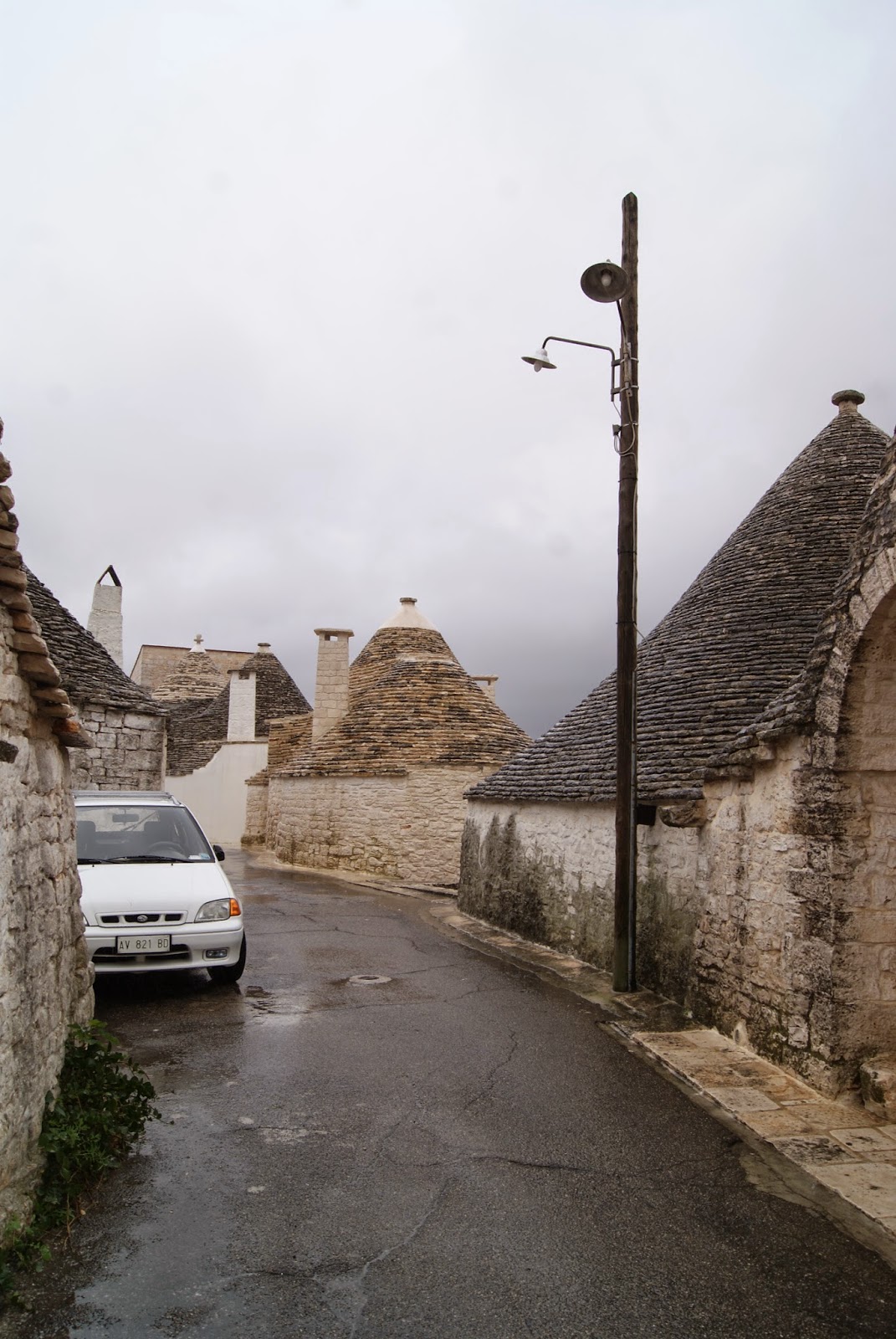
And that is how I somehow end up wandering a deserted street of trulli in Alberobello, by myself, in the pouring rain. My shoes are wet, my rain coat has completely soaked through and I am surrounded by this charming, miraculous beauty which I have all to myself. It would be absolutely magical--if I weren't so incredibly miserable.
So I duck under the porch on someone's delightful little holiday house, as the rain pours sideways, soaking me even more and I ask myself, what sane person would do this?
And the universe answers back to me, only a completely insane person would find themselves in this situation.
So I take a moment to evaluate my own actions over the past twenty-four years that have led me up to this exact time and place and suddenly everything becomes clear. Yes, completely insane, that sounds about right.
And at a moment like this, all I can do is laugh: at this place, at this rain and mostly at myself.
Laugh and promise myself an extra glass of wine at lunch (if I ever find lunch).
And pray that someone will sell me dry trullo-themed socks.
And remind myself that humility is certainly something the world could use a bit more of.
And it is in moments like these that I inevitably feel my foot falling into a crack in the cobblestones as I'm walking along and I know that I am powerless to prevent what is about to happen. And I fall down. On my face. In the middle of the street. In front of dozens of people.
Humility is certainly something that the world could use a bit more of and at moments, it certainly feels like there is someone out there making sure that I have my fair share. (That thing about falling on my face, that's not a metaphor, by the way.)
But I admit that sometimes these not-so-subtle reminders are needed. Because occasionally I decide, in my own mind, for whatever reason, that I personally run the world. I see rain in the forecast and (ever the optimist) I decide that it will not rain today. I decide to travel to a new town, which I have never visited before because, despite all indications to the contrary, it is going to be beautiful today. Being something of an over-confident traveler, I also decide on this particular day that I instinctively know how to arrive to the city center from the train station and that I do not need to ask for directions. (Anyone who knows me well or has ever traveled with me knows that there is absolutely ZERO precedent in my life to indicate that I instinctively know the way anywhere. Not ever. Not one single time.)
And that is how I somehow end up wandering a deserted street of trulli in Alberobello, by myself, in the pouring rain. My shoes are wet, my rain coat has completely soaked through and I am surrounded by this charming, miraculous beauty which I have all to myself. It would be absolutely magical--if I weren't so incredibly miserable.
 |
| Uhm...hello....is anybody there? Anybody? |
So I duck under the porch on someone's delightful little holiday house, as the rain pours sideways, soaking me even more and I ask myself, what sane person would do this?
And the universe answers back to me, only a completely insane person would find themselves in this situation.
So I take a moment to evaluate my own actions over the past twenty-four years that have led me up to this exact time and place and suddenly everything becomes clear. Yes, completely insane, that sounds about right.
And at a moment like this, all I can do is laugh: at this place, at this rain and mostly at myself.
Laugh and promise myself an extra glass of wine at lunch (if I ever find lunch).
And pray that someone will sell me dry trullo-themed socks.
And remind myself that humility is certainly something the world could use a bit more of.
 |
| In the end, it did turn out to be a beautiful day. So maybe I was right after all? |
 |
| Alberobello and I parted on good, if soggy, terms. |
Tuesday, September 2, 2014
Yellow Leaves
.JPG)
I was stopped in my tracks the other day by the first tree with yellow leaves. I just stood there as we confronted each other-- me with all my preconceived notions of what a tree should look like during the month of August, it with its own defiant existence speaking for itself.
In that moment, I was so surprised by the sudden change that I had not yet built up my own existential defenses. And I've been trying this whole time to put a label on the feeling that assaulted me in that moment when I had my guard down. It was something like awe-- seeing the power of nature in its earliest moment of visible change. But it was also something like dread, the yellow leaves having always been for me something of a memento mori. At the same time, it was something like joy, a looking forward to scarves and new olive oil and young wine. But it was also a deep, lamenting sadness, knowing that the days of tingling sunshine warmth on bare skin are numbered. And so I found myself standing dumb-founded in the piazza like an idiot, laid emotionally bare at the sight of a single tree, with this almost-awe, almost-dread, almost-sadness, almost-joy coming together in an aching knot in the pit my stomach.
I speculate that I find myself so defenseless, so powerless in the face of the onset of the Fall because I grew up in place where the fluctuation of seasons was minimal. When the variety of seasons ranges from not-that-cold to warm to hot to inferno, the changing of the leaves is less dramatic and the change in temperature and life even less so. Although I grew up coloring pictures of yellow leaves as backdrops for turkeys and pumpkins, I did not so much recognize them in the world around me and so I don't yet take this endless, beautiful cycle of death and re-birth for granted.
In the moment when those yellow leaves entered my consciousness and I was feeling in my gut and in my bones that wrenching and releasing, I was somehow feeling how many times this moment, this breathless moment at the cusp of two seasons, had existed without me here to witness it and how many times it will continue to exist when I am long gone. And in confronting these yellow leaves, I am standing face-to-face with how little this whole system has to do with my own wishes and desires, how little control I have and that ultimately, I am but a single, microscopic piece of something incomprehensibly bigger than myself.
.JPG)
I can't help but think that this is all good preparation for the day when I will wake up and again be stopped in my tracks by the yellowing of my own leaves. I hope that I will remind myself of and take consolation in the beautiful, fiery Fall landscapes and the abundance of the autumnal harvest. And when the yellow leaves of my own Autumn yield to the brown of Winter, as they inevitably do, I hope I'll remember how equally inevitably, the brown of Winter always yields to the fresh, hopeful green of Spring.
Subscribe to:
Posts (Atom)